

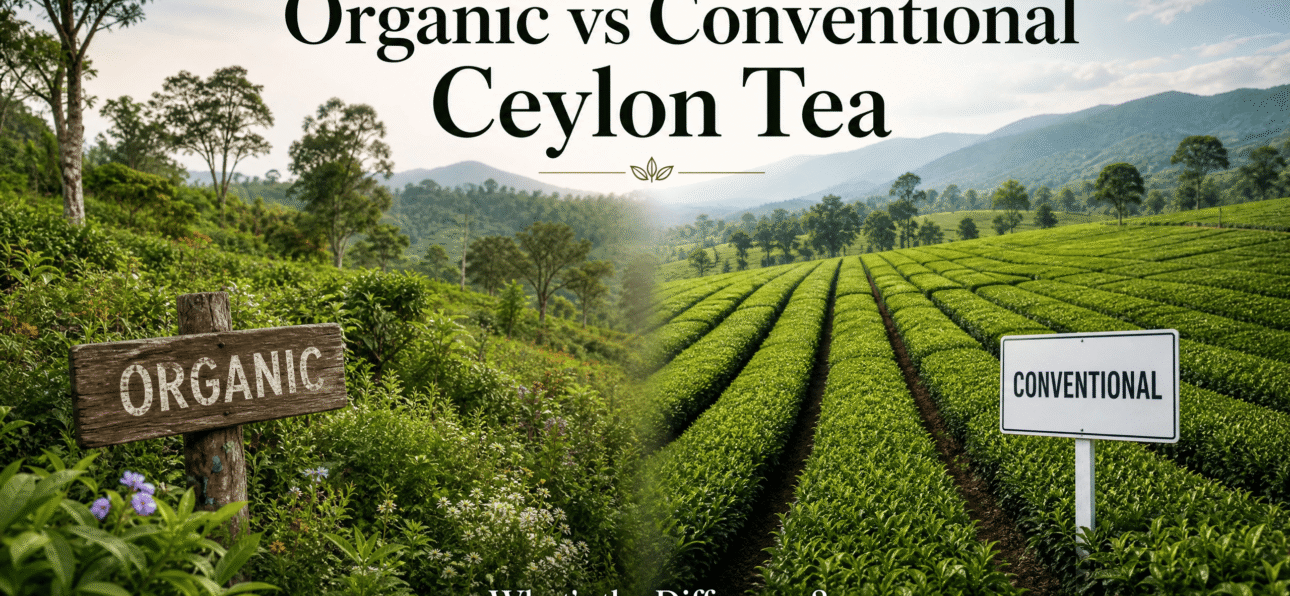
If you have ever stood in front of a tea shelf (or a tea supplier’s catalogue) and felt slightly overwhelmed, you are not alone. One tin says “organic”, another says “pure Ceylon”, another says “herbal”, and they all look like they are promising the healthiest cup of your life.
So let’s slow it down and make it practical. What does “organic” really mean for Ceylon tea, what counts as conventional, and how do you choose the best option for your taste, budget, and values?
First, what is Ceylon tea?
Ceylon tea is tea grown and produced in Sri Lanka. It can be black, green, white, or oolong, because those “types” are mostly about processing, not the plant itself. Tea is made from the leaves and buds of the tea plant, Camellia sinensis.
Sri Lanka is also known for distinct growing regions such as Nuwara Eliya, Dimbula, Uva, Kandy, Ruhuna, and Sabaragamuwa, which can influence flavour and character.
Organic vs conventional tea in one simple sentence
Organic tea is tea produced under a recognised organic standard, verified by audits and documentation.
Conventional tea is tea that is not certified organic (it may still be high quality, but it is not operating under organic certification rules).
That is the key point: organic is a certification system, not just a vibe.
What “organic” really means in practice
Organic rules vary slightly by country, but they share common principles.
Organic farming generally means
- Most synthetic pesticides and fertilisers are not allowed, except specific permitted substances.
- GMOs are prohibited under major organic standards.
- Records, inspections, and traceability are required.
For example, in the United States, USDA organic rules rely on a National List that spells out what is allowed and what is prohibited, with a general principle that synthetics are prohibited unless specifically allowed.
In the EU, organic production and labelling are governed by Regulation (EU) 2018/848 and related rules under the European Commission.
Important reality check
Organic does not automatically mean “chemical free”. Organic systems can still use certain approved inputs. Also, things like pesticide drift from nearby farms can happen, which is why serious suppliers rely on traceability and, often, residue testing alongside certification.
What is “inorganic tea”?
People sometimes say “inorganic tea” when they really mean “non-organic” or “conventional”. In tea trade terms, the usual comparison is organic vs conventional, not organic vs inorganic.
So if a buyer asks for “inorganic tea”, clarify what they mean:
- Do they mean standard conventional tea?
- Or are they asking for something specific about fertiliser or residue limits?
Is organic tea always better?
This is where we need to be honest.
Organic can be better if your priority is
- Farming system and input restrictions
- Brand positioning for organic-focused markets
- Meeting specific retailer requirements (especially in premium health or eco segments)
Conventional can be better if your priority is
- Wider availability of grades, origins, and seasonal lots
- Consistent price at large volumes
- Specific flavour profiles achieved through particular agronomy and processing choices
There is also a taste and chemistry layer. Some research comparing organic and conventional teas reports differences in certain compounds, but results are not always consistent across regions, seasons, and processing styles. One 2023 study reported higher levels of several catechins in organic samples, while some amino acids were higher in conventional samples. That basically translates to potential differences in bitterness, sweetness, and mouthfeel, depending on the tea.
So “better” depends on what you value and what you drink daily.
Where “loose leaf herbal tea” fits in (and why it confuses people)
This keyword comes up a lot because many people shop by health goal, not by plant.
Herbal tea (like peppermint, hibiscus, ginger, lemongrass) is usually not true tea. It is an infusion made from herbs, flowers, or fruit.
True tea (black, green, white, oolong) comes from Camellia sinensis.
So you can absolutely buy organic loose leaf herbal tea, but it is a different category from Ceylon tea. It is best to explain this clearly in the blog so readers do not feel tricked.
Organic loose leaf tea and organic loose leaf green tea: how to choose well
If you are shopping for organic loose leaf tea, here is a checklist that works for both everyday drinkers and serious buyers.
1) Look for a real certification claim
You want language like “certified organic” plus a certifier name, not just “natural” or “eco”.
Sri Lanka also has organic certification frameworks and accredited certification bodies. Control Union Certifications notes it operates organic certification programmes in Sri Lanka, including local organic agriculture standards.
2) Check the tea type and purpose
- Want a brisk cup with milk? Choose black tea.
- Want a lighter cup and often lower caffeine? Choose green tea.
(Organic status is separate from type.)
3) Choose loose leaf if you care about aroma and control
Loose leaf often gives you more control over strength and flavour, and many people use less sugar when the tea naturally tastes better.
4) Match the tea to your palate
If a tea feels too bitter, it is often over-brewing rather than “bad tea”. Organic green tea especially can turn sharp if steeped too long or with boiling water.
What is the best organic loose leaf tea?
The best organic loose leaf tea is the one you actually enjoy enough to drink without turning it into a dessert.
A simple way to decide:
- If you love fresh, clean flavours: try organic loose leaf green tea
- If you want bold comfort: try organic loose leaf black tea
- If you want caffeine-free: choose a loose leaf herbal tea (and you can still choose organic)
FAQs
Is Ceylon tea organic?
Ceylon tea can be organic, but it is not automatically organic. “Ceylon” describes origin (Sri Lanka). “Organic” describes a certified production standard. Look for certified organic labelling and a certifier or standard reference.
What are the different types of Ceylon tea?
The main types are black, green, white, and oolong. These types come from the same tea plant (Camellia sinensis) but are processed differently.
What is the difference between organic and inorganic tea?
In everyday use, people usually mean organic vs non-organic (conventional). Organic tea follows certified organic standards with inspections and input restrictions. Conventional tea is not certified organic.
Why is organic tea better?
Organic tea can be “better” if you value certified farming practices, input restrictions, and organic market positioning. But it is not automatically higher quality in taste. Quality still depends on the garden, season, pluck standard, and manufacturing skill.
Is there any real difference between organic and non-organic?
Yes, there can be differences in farming rules, documentation, and sometimes in flavour or chemical composition. But the cup difference is not guaranteed. Two teas, one organic and one conventional, can both be excellent.
